
Psychic Insights
Tarot Spreads for Beginners: 5 Simple Layouts to Try

A tarot card on its own is a single idea. A tarot spread is the layout that turns a handful of cards into a story. Where each card lands, and what that position stands for, decides how you read it. If you are new to tarot, a simple spread is the easiest way to practice, and it also helps you follow along when a reader lays cards out during a session.
This guide walks through five beginner-friendly layouts, from a one-card daily pull to a five-card decision spread. You will find what each position means, which kinds of questions suit each layout, and tips for reading the cards without overthinking them. Tarot works best as a tool for reflection, so use these spreads to organize your thoughts, not to demand certainty about the future.
What Is a Tarot Spread?
A spread is a pattern you lay cards into, with each position given a meaning before you turn the cards over. Instead of asking “what does this card mean?”, you ask “what does this card mean in this position?” A card in the “challenge” position reads differently from the same card in the “strength” position.
Spreads give your question a structure. They also keep a reading from drifting. If you want a refresher on individual cards before you begin, our beginner’s guide to tarot card meanings covers the major and minor arcana.
Before You Lay a Single Card
A little preparation makes any spread more useful.
- Frame an open question. “What should I focus on this month?” gives you more to work with than “Will I get the job?” Our list of questions to ask a psychic has plenty of open-ended examples that work just as well for tarot.
- Pick your deck. Choose one whose artwork feels clear to you. The Rider-Waite-Smith style is common for beginners because its scenes make each card easier to read.
- Shuffle with intention. Shuffle however feels comfortable while holding your question in mind, then cut or draw the cards.
- Decide the positions first. Say aloud what each spot stands for before you flip anything over.
Spread 1: The One-Card Daily Pull
The simplest layout is a single card. Draw one in the morning and treat it as a theme for the day, or ask a focused question and read the answer as a prompt.
How to Read It
- Look at the image first and note your gut reaction before checking any meaning.
- Ask what quality or lesson the card invites you to bring to the day.
- Write down one sentence about it, then review that sentence in the evening.
This is a good habit for building familiarity with the deck. Over a few weeks, you will start to recognize patterns in how you interpret certain cards.
Spread 2: The Three-Card Past, Present, Future
The three-card spread is the classic beginner layout. Lay three cards in a row from left to right.
- Card 1, Past: influences that led to the current situation.
- Card 2, Present: where things stand right now.
- Card 3, Future: a possible direction if current patterns continue.
Making It Work for You
Treat the third card as a trajectory, not a prediction carved in stone. Your choices still shape what happens next. The same three positions can be reused as “situation, obstacle, advice” or “mind, body, spirit,” which makes this layout very flexible.
Spread 3: The Situation, Challenge, Advice Spread
When you are stuck on a specific problem, this three-card variation is often more actionable than past-present-future.
- Card 1, Situation: the heart of the matter.
- Card 2, Challenge: what is getting in the way.
- Card 3, Advice: an approach worth considering.
It suits everyday dilemmas such as a difficult conversation, a stalled project or a decision about timing. If your question is about work, you may find the career psychic reading guide useful alongside it.
Spread 4: The Relationship Spread
For questions about love, friendship or family, a four-card layout lets you look at both sides of a connection.
- You: what you bring to the relationship right now.
- The other person: how they may be experiencing it. Read this as a perspective to consider, not a mind-reading exercise.
- The connection: the dynamic between you.
- Guidance: a way to nurture or clarify it.
Relationship readings can stir up strong feelings, so go slowly and be kind to yourself. If a card feels harsh, ask what it might be pointing to rather than accepting it as a final judgment. For more on connection themes, see our article on twin flames versus soulmates.
Spread 5: The Five-Card Decision Spread
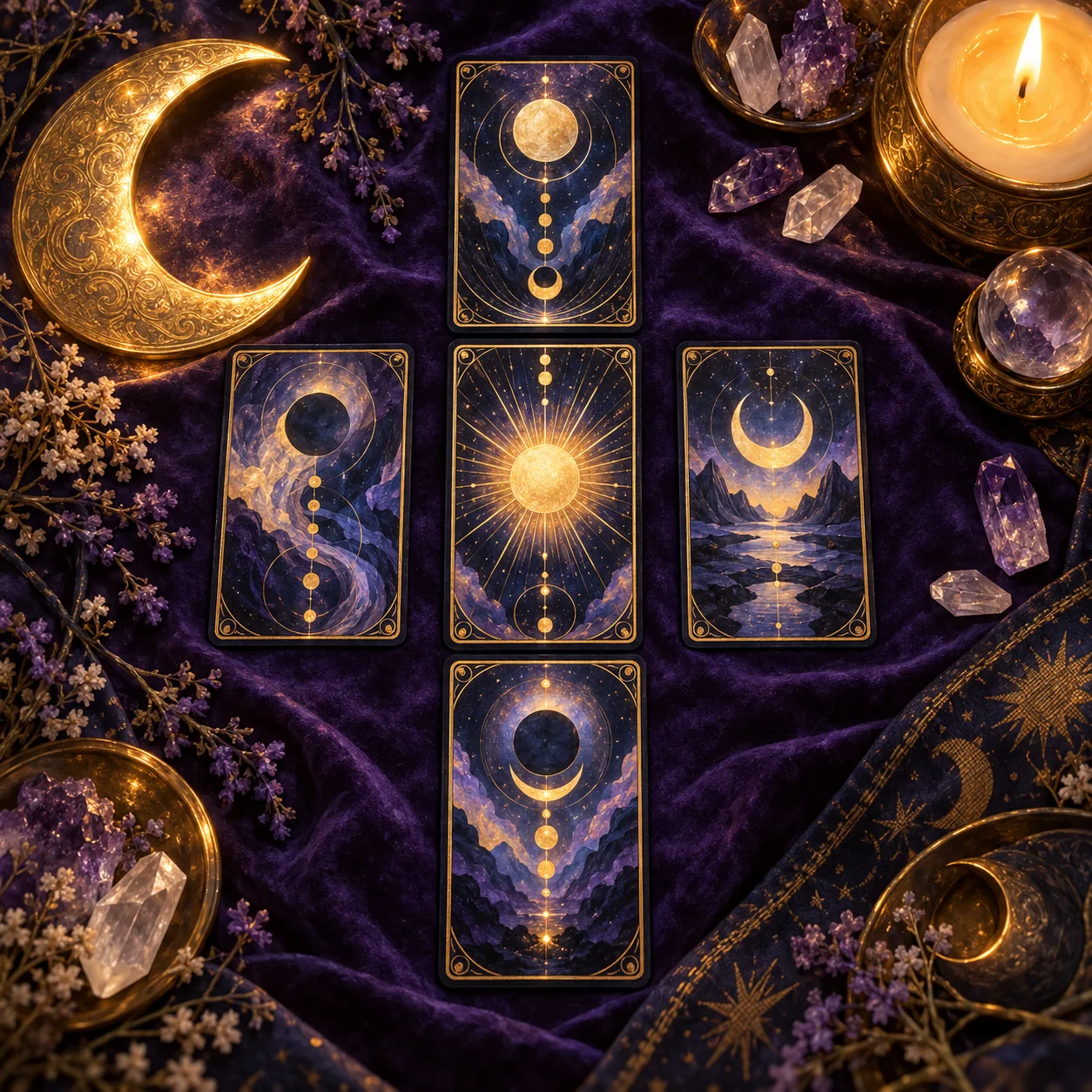
When you are weighing two options, five cards give you room to compare them. Place the cards in a row or in a plus shape.
- Card 1, Where you are: the current position.
- Card 2, Option A: what choosing the first path might bring.
- Card 3, Option B: what choosing the second path might bring.
- Card 4, Hidden factor: something you may be overlooking.
- Card 5, Guiding principle: a value to keep in mind whichever way you go.
The aim is not to have the cards decide for you. It is to surface considerations you can weigh with your own judgment. If you have been wondering whether it is time to seek outside perspective, the signs you need a psychic reading can help you think that through.
Tips for Reading Spreads Without Overthinking
- Read the whole spread, not just single cards. Look for repeated suits, numbers or colors, and notice how neighboring cards seem to speak to each other.
- Notice reversed cards gently. If you use reversals, think of them as an inward or blocked version of the card’s energy. If they confuse you at first, leave them out.
- Trust the image. Your first impression of the artwork is a valid starting point. Then check it against a reliable meaning.
- Keep a tarot journal. Record the date, question, spread and your reading. Reviewing it later shows how your interpretations develop, and it keeps you honest about what actually happened.
- Do not repeat the same question. Drawing again and again until you get an answer you like defeats the purpose. Sit with the first result.
Common Beginner Mistakes
Asking Yes-or-No Questions
Tarot is stronger at describing dynamics than at giving binary answers. Rephrase to “What do I need to understand about…?” for richer results.
Reading Fear Into Difficult Cards
Cards such as Death, the Tower or the Devil sound frightening, but they usually point to change, upheaval or unhealthy patterns, not literal disaster. Read them in context.
Treating the Cards as Fixed Fate
A spread describes a snapshot of possibilities. It does not remove your agency, and it should never replace professional medical, legal or financial advice.
When a Live Reader Can Help
Self-reading is rewarding, but sometimes an outside perspective makes a pattern easier to see. Experienced readers can walk you through why a card sits where it does and connect the spread to your actual circumstances. If you are curious how this works in practice, read about what to expect from a first free psychic reading and how to prepare. Afterward, our guide to psychic reading aftercare offers ideas for reflecting on what you heard.
To understand how we present readers and what to watch for, see how it works and our editorial policy.
Frequently Asked Questions
How many cards should a beginner use?
Start with one to three cards. Short spreads are easier to interpret and help you learn the cards without feeling overwhelmed. Move to larger layouts once reading three cards feels comfortable.
Do I need a special deck?
No. Any standard 78-card tarot deck works. Choose artwork that you find clear and engaging, since you will be looking at it a lot.
Can I read tarot for myself?
Yes. Many people read for themselves as a reflective practice. If a topic feels too emotionally close, a friend or a professional reader can offer a fresher view.
How often should I do a spread?
There is no rule. A daily one-card pull and an occasional deeper spread for big decisions is a common rhythm. Avoid overusing tarot as a way to avoid making choices yourself.
Take the Next Step
Practice a simple spread this week, journal what you notice and let your interpretations grow. When you are ready for a conversation with an experienced reader, you can Get a Free Reading and see how a live session approaches the same cards.

Written by Isabella Reyes
Isabella Reyes is a tarot reader and intuitive counselor who has practiced professionally for over a decade. Her readings focus on love, life direction, and spiritual growth, and she writes about tarot practice and intuitive guidance for the Free Psychic blog.
Talk to a Specialist — First Minutes Are FREE
New to Free Psychic? Every advisor below offers introductory free minutes so you can test the connection before any paid time begins.

Percival Sinclair
First 3 minutes FREE
$6.48/min
after free minutes

Sage Hollow
First 3 minutes FREE
$2.40/min
after free minutes

Ivy Wilde
First 3 minutes FREE
$1.90/min
after free minutes

Marcus Linden
First 3 minutes FREE
$4.32/min
after free minutes
← Previous Article
Clairvoyance, Clairsentience & Claircognizance: The Four Clairs Explained